
Women’s History Month
 March 20 marks the first day of spring this year. We have already done the “spring forward” two-step. As important, Women’s History Month is celebrated in March. My mother’s birthday was March 19, so this month is a concurrence of events in my life. Many famous women are being noted in March. I prefer to note the wonderful women in my own family.
My great Aunt Apal Friedline, my mother’s aunt, gathered our family stories together and wrote a book, Generations (Caxton Press, 1941), illustrated by my mother, Marie Whitesel. Apal used her imagination in telling the tales of my forebears and their push to move West, along with their lives in Boise and Meridian, Idaho. In May, 1878, my great-great-grandparents (Aunt Apal’s grandparents), Isaac and Margrette Pfost and their family of five children purchased a wagon and packed it with all they owned. They joined with other families to cross the prairies and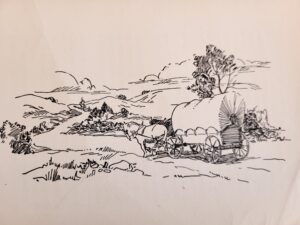 mountains from Missouri, heading for Oregon. Their trip was hot, dry, and dangerous, although no Indians threatened the journey, only lack of water, death of animals, and sometimes lack of food. My Aunt Apal describes their first view of Boise in August, 1878: Shouts of joy rang along the wagon train as the beautiful green valley spread before them. They followed the Boise River to Government Island, where they made camp. They could see why Boise City had derived its name from the party of French Canadian voyageurs in 1834.
The wagon train rested near the Boise River to re-supply. Margrette was travel weary, as were other women in the camp. She wanted to remain and persuaded Isaac to do so. Isaac found a small house for $40 a month. He took odd jobs—clearing sagebrush and planting trees. Isaac and Margrette shared the one bed they owned and the children slept on feather beds on the floor. Margrette learned she was pregnant. She knew they needed more money, and her daughter Mollie needed decent clothes. Secretly, she worked for a lady down the street, earning some dollars. Finally, she told Isaac what she was doing: “Women must fight side by side with their husbands for the home that is made in the West, for a chance at better things, for enough food and clothes for the children, and for their right to an education. Education means clothes. Life in the West is different: here life is a challenge.”
Margrette and Isaac’s daughter Mollie married Martin Burns, my great-grandfather, who also emigrated from Missouri. He was much older than Mollie and worked in the North Star mine in Ketchum at the time he married Mollie in 1885. Eventually, they moved back to the Boise area because Margrette was quite ill and soon died. Mollie and Martin had five children, two born on a homestead in Meridian. Grover, the oldest, established the Burns Photography Studio in Boise. My grandmother Elsie was also born in Meridian and attended college at the University of Idaho and then at Albion, a teacher’s college. Almia, Apal, and Waldo were all born in the Boise area where Martin had opened a store selling general merchandise. Isaac and Martin also sought gold in the Seafoam Mining area, north and west of Stanley, Idaho, near the Josephus lakes. A family legend bragged about a bag of gold buried there. Elsie taught school in Cambridge, Idaho, where she met my grandfather Frank, a railroad man. He spent his career with the Union Pacific, beginning as a telegrapher after the eighth grade and rising to be in charge of all the freight in the West. Elsie occupied herself by buying property around Boise and in McCall. 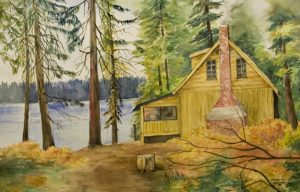 She always dressed her best in a silk dress, high heels and hat with a veil, wearing large beads, earrings and rings. She was ready to deal.
My mother, born in Fruitland, Idaho, grew up in Twin Falls. She attended the University of Idaho and the University of Iowa, obtaining degrees in art. She and my father married in 1939 and moved to Chicago where he obtained his medical degree. After the war, they settled in Kellogg, where I and my siblings grew up. Mother taught art and Dad practiced medicine.
 On the window sill of my office in Hailey, Idaho rest two photographs from the Burns Studio in Boise. My mother and her two cousins, Marthlyn Burke and Fern Lucille Burns, look out at me. They are young, fresh-faced, and beautiful.
 Each cousin grew strong and brave and entered the world. Marthlyn (lower left) attended Stanford and joined the Red Cross, traveling to Europe during WWII. There, under the Eiffel Tower in Paris, she celebrated V-E Day and accepted the proposal of Jim, a major in the US Army. Together, they owned and ran an insurance brokerage for many years.
Fern Lucille (upper left) grew up in Boise, and then followed her father Grover in photography. She worked with Ansel Adams one summer. When her father fell ill, she took over the Burns Studio when she was nineteen. During WWII, silver for the black and white photographs became difficult to obtain, so she closed the studio.
My mother, Marie Whitesel (right), painted her whole life. She was in turns glamorous, wearing swirly evening clothes and Chanel No. 5 perfume when she and my father went out for the evening to dance, or ordinary—an everyday housewife. She served on many women’s organizations, always rising to the top. Over the years and after my father died, she became increasingly involved with the University of Idaho, elected as the first woman leader of the Alumni Association and serving on the UI Foundation Board. The University awarded her an honorary doctorate degree. It also held numerous exhibits of her artwork, including a major retrospective. One of her etchings hung in the New York World’s Fair in 1938. She painted Idaho.
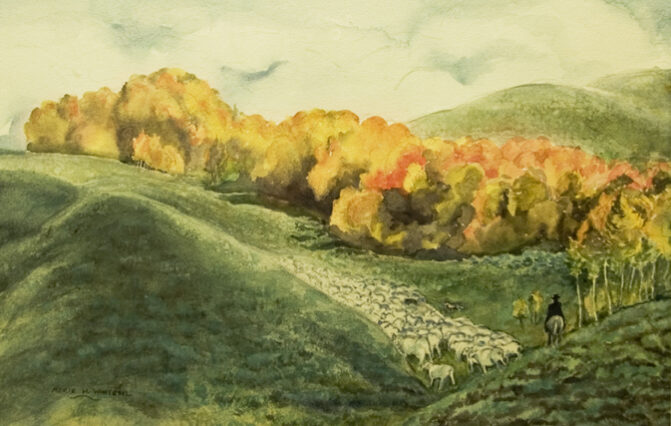

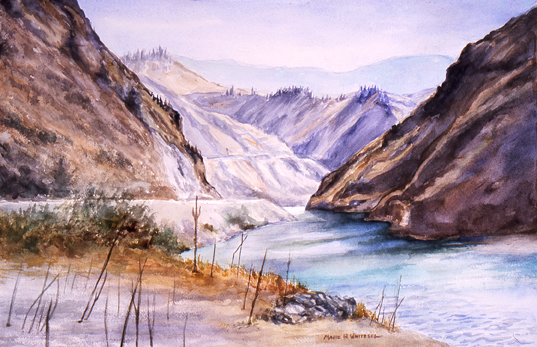
My mother’s generation inspired me to go to law school when few women did. After thirty-some years practicing law in Seattle, I turned to writing about Idaho, the home of my heart. I have traveled to Josephus Lakes where my great-great-grandfather and my great-grandfather mined for gold. My husband and I didn’t spend time looking for gold nuggets. Instead, we fished for rainbow trout. The heritage my ancestors and my mother and father left me was worth more than a sack of gold: a love of Idaho, its high hidden lakes, its sagebrush deserts and the saw teeth of the central mountains tearing the sky. The mountain ranges of both southern and northern Idaho: Pioneers, Smokeys, Boulders, Sawtooths, White Clouds, Bitterroots, Lost River and Salmon River Ranges. The clear waters of Payette Lakes set amid the tall pines of Idaho forests. These are the places my family gave to me.
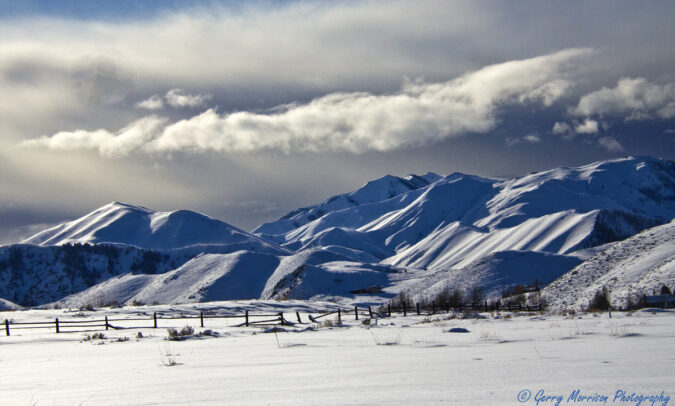
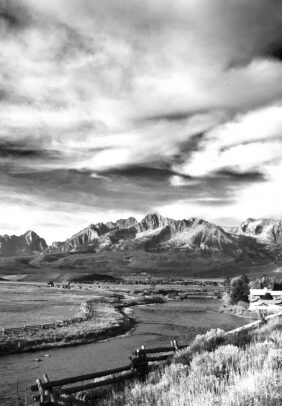

And I give to you the titles of books I can highly recommend, books by and about mostly women:
These Precious Days by Ann Patchett
Song of Achilles and Circe by Madeline Miller
We Should All be Feminists by Chimamanda Ngozi Adichie
Powder Days by Heather Hansman
Woman Inscribed by Margaret (Peggy) Grove
Okay, okay—and a few by men:
The Thursday Murder Club by R. Osman
Facing the Mountain by Daniel James Brown
Chasing History by Carl Bernstein
The Apollo Murders by Chris Hadfield
And don’t forget, my newest Nellie Burns and Moonshine Mystery, MINERS’ MOON, 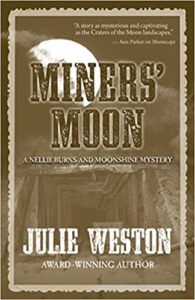 came out in December, 2021. You can find it at your local bookstores, Indiebound, or Amazon. Paperback and ebooks of my earlier Moon books should be available soon. I will be giving a program at the Idaho State Historical Museum on May 19. If you’re in Boise, please come!
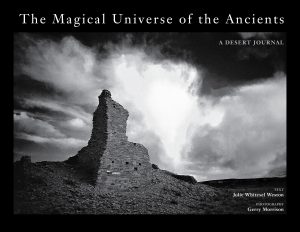
The Magical Universe of the Ancients, a Desert Journal, with photography by Gerry Morrison and my journal is available at bigwoodbooks.com or on Amazon. If you plan to travel into the Four Corners area, it is a must buy. If you care about the Bears Ears Monument and other monuments and national parks, it is also a must buy. Paintings and drawings by Marie Whitesel Photographs by Gerry Morrison (except the three cousins)
Very interesting, Julie. It’s wonderful that your family has kept such detailed records. You have a family of interesting women!
Thank you, Mary. I do indeed have an interesting family.
Wonderful post, Julie. Thank you.
Thank you, John!
I had tried each day to reach your websitw and it didn’t work. Finally, today, it did. You have reason to be very proud of your ancestors and their stories. Enjoyed this immensely.
Thank you, Irene. I’m sorry you had trouble getting to my website. Like you, I have interesting ancestors. 🙂
Your family history is fascinating and filled with people of energy and activity for the common good. People who never left behind their artistic talents. People with fresh-faced outlooks. Good bones, good hearts, good lives. Thank you for presenting this blog entry. Their world had its own versions of chaos and threats, as our world does today. Reflection on their lives gives strength to what we do today for others and ourselves. Here’s wishing you all the best, Julie. Beautiful Idaho hurray!
Thank you, Penny. I enjoyed reading your comments. In writing this blog, I did reflect on what strengths the women in my family had and passed along to me. They truly were unusual for their time. I think each of us in our families have faced our various chaos and threats. Right now seems full of threats that we must face.
I loved reading about the family history! Thanks for sharing
Lucy, so nice to hear from you. Thank you. You come from a long line of strong women!
How wonderful to read of all of the smart and talented women in your family, and the drive you inherited! And it’s lovely to see your mom’s paintings with Gerry’s glorious photos–they compliment each other well.
Thank you, Susan. I do enjoy looking at my mother’s paintings and Gerry’s photographs. Sometimes, my mother painted from Gerry’s photographs and they are always interesting to see side by side. I am lucky to have so much talent in my close family.
This is Anne Elliott. My father was Stephen Haasch, your cousin. I love to read these stories! Is there any way to get a copy of the Generations books from 1941? Thank you for sharing all of this.
Hi Anne, Thank you for reading my blog. We certainly have strong and fascinating women in our family, don’t we? I’ll send you a note about Generations.